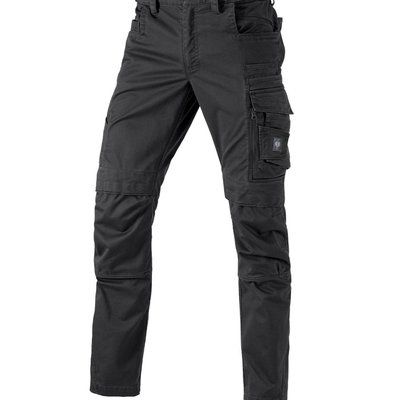
For trades and industry, trousers take more abuse than any other garment. The difference between a pair that lasts one season and one that lasts three is rarely the fabric alone — it's the construction at the stress points.
The construction features that matter
| Feature | What it does | Where it counts |
|---|---|---|
| Triple / double stitching | Multiple seam rows so one broken thread doesn't open the seam | Crotch, inseam, side seams |
| Bar-tacking | Dense reinforcement stitch at stress points | Pocket corners, fly, belt loops |
| Ripstop weave | Grid of stronger yarns that stops tears spreading | Trades around sharp edges, brush, tools |
| Knee-pad pockets | Insert pockets for CE knee protection | Flooring, tiling, kneeling trades |
| Cordura / reinforced panels | Abrasion-resistant fabric at high-wear zones | Knees, seat, tool-pocket edges |
Cargo vs straight worker trouser
Cargo trousers add multi-pockets — useful for carrying tools, tape, phones and fasteners without a belt rig. Straight worker trousers are cleaner and preferred where a tidy look matters or where loose pockets are a snag hazard. Many trades now use a cargo with bellows pockets that lie flat when empty.
Specify the fabric by weight and blend: a 240–300 GSM poly-cotton drill balances comfort and durability; a 100% cotton drill breathes better near heat (welding, kitchens); ripstop suits trades exposed to tearing. State the trade and we'll match it.
Fit & comfort
- Articulated / pre-bent knees: let the leg bend without the fabric binding.
- Gusseted crotch: a diamond panel that removes the most common blow-out point.
- Stretch panels: a little elastane at the waist and back for all-day movement.
- Part-elasticated waist: fits a wider size range from one SKU.
Quick recommendation
- General trades, tool-carrying → cargo, 260–300 GSM poly-cotton, triple-stitched.
- Kneeling trades → add knee-pad pockets + Cordura knee panels.
- Tidy / customer-facing → straight worker trouser with bar-tacked pockets.