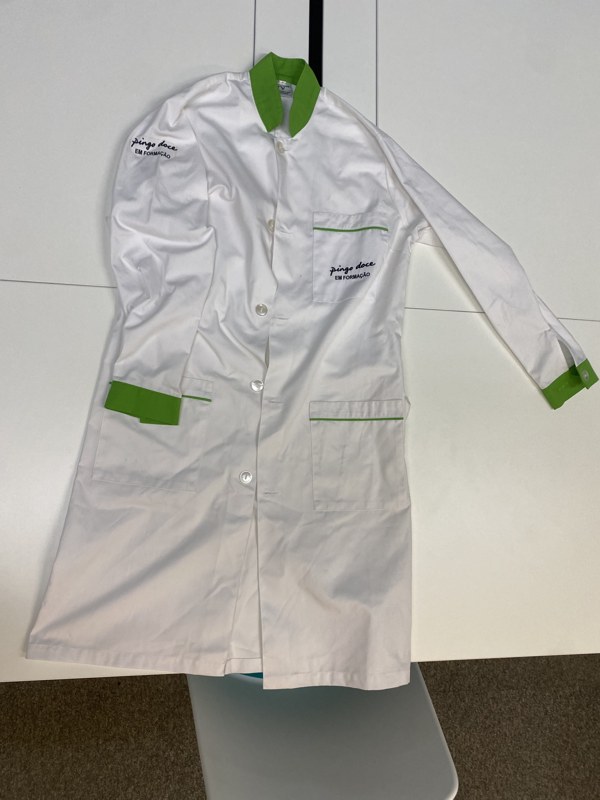
Hygiene-led environments share a requirement: garments must be cleanable at high temperatures, hold colour and shape through constant industrial laundry, and protect the wearer. That shapes every spec decision.
Garment by setting
| Setting | Garment | Key requirement |
|---|---|---|
| Laboratory | Lab coat (long sleeve, buttoned) | Coverage + easy removal; often flame-resistant or anti-static |
| Clinic / care | Medical tunic & trouser | Comfort, movement, high-temperature wash |
| Professional kitchen | Chef jacket + apron | Heat protection, stain release, breathability |
| Food production | Coat / smock, snap closures | No loose buttons (foreign-object control), wash durability |
Fabric & finish
The default for hygiene wear is a poly-cotton blend (typically 65/35) at 190–245 GSM: the polyester carries colour and shape through 60–90°C laundry while the cotton keeps it comfortable and breathable. Common functional finishes:
- Stain-release: helps food and biological stains lift in the wash.
- Anti-static: a carbon grid for electronics labs and clean rooms.
- Fluid-repellent: sheds splashes in clinical and lab settings.
- Antimicrobial: reduces odour and bacterial build-up between washes.
Compliance note
Food-production garments often require concealed or snap closures and no external pockets above the waist to prevent foreign-object contamination. Tell us the sector and we'll build the garment to its hygiene rules.
Details that earn their place
- Colour: white shows cleanliness in labs; darker tones hide stains in kitchens — choose by priority.
- Closures: press studs are faster and safer than buttons in food settings.
- Sizing: unisex blocks with adjustable cuffs simplify stock across a mixed team.
- Branding: embroidery survives high-temperature laundry; heat-transfer often won't.
Quick recommendation
- Lab → buttoned coat, 210–245 GSM poly-cotton, fluid-repellent / anti-static as needed.
- Clinic / care → tunic + trouser, stain-release, 60°C+ wash.
- Food production → snap-closure coat, no upper pockets, wash-durable blend.